
Migraine Science
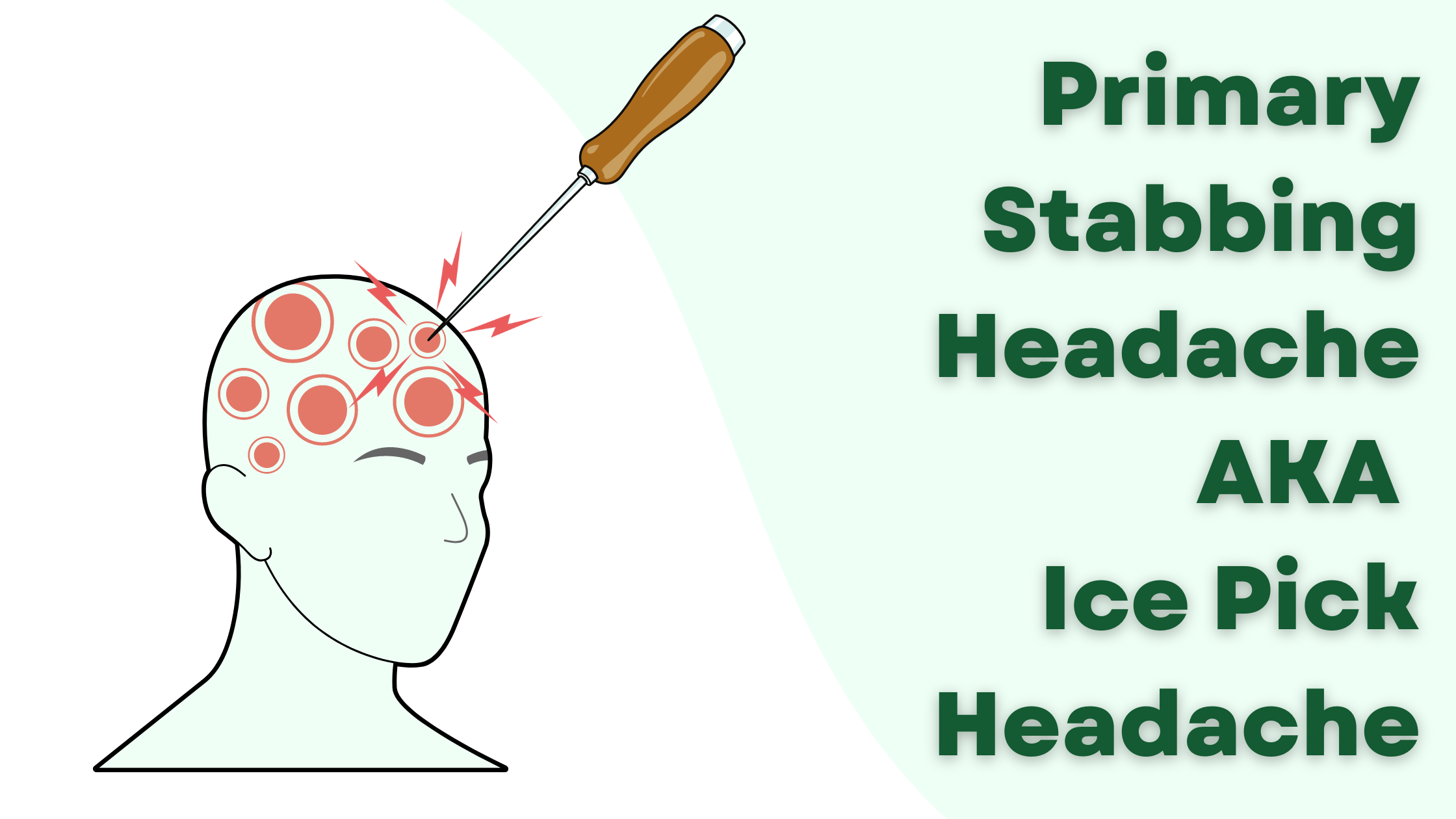
Primary Stabbing Headache aka Ice Pick Headache (symptoms, pathophysiology, diagnosis, and treatment)
Stay in the Loop on the Latest in Migraine:


Primary stabbing headache is also known as ice pick headache, ice pick pain, idiopathic stabbing headache, ophthalmodynia periodica, needle-in-eye syndrome, sharp short-lived head pain, and jabs and jolts syndrome.
Many patients with migraine have comorbid primary stabbing headache and hence why it is important to talk about.
As the ICHD-3 describes it, primary stabbing headache is characterized by transient and localized stabs of pain in the head that occur spontaneously in the absence of organic disease of underlying structures or of the cranial nerves.
Clinical Features
Patients describe the head pain as sharp, knife-like stabs or jolts affecting the head. While the stabs are very brief (transient), usually a couple seconds, some patients report longer stabs persisting for up to several minutes (however, studies show that 80% of stabs occur for 3 seconds or less). Wincing is common especially with single, intense stabs, but a stab may also occur with varying intensity within the course of a single stab.
The location is variable – often moving from one area to another in either a unilateral or bilateral fashion. Stabs can occur anywhere on the head (70% of cases are in the areas not innervated by the trigeminal nerve aka extratrigeminal region), including the face, scalp, and neck. If the pain is always in a fixed location (1/3rd of people), a structural pathology needs to be ruled out.
The frequency of stabs is highly variable. Most patients experience only occasional stabs- one or a few per day, while others report dozens or even hundreds of stabs per day (therefore, it must be distinguished from other trigeminal autonomic cephalalgias, but, fortunately, primary stabbing headache does not have autonomic symptoms). Stabbing headaches often occur in unpredictable episodic patterns, with symptom-free periods lasting weeks to months between active episodes.
In one case report, a patient had “ice-pick status” with minute long stabs lasting a week.
https://headachejournal.onlinelibrary.wiley.com/doi/10.1111/j.1526-4610.1995.hed3502107.x
Though intense, the very short duration means the head pain itself is not usually disabling. However, frequent stabs can be distracting and distressing. Associated nausea, vomiting, photophobia, and phonophobia can also occur during more severe episodes.
Epidemiology and Demographics
Lifetime prevalence of primary stabbing headache is around 2%. Females are impacted more often than males (1.5:1). While more research is needed on incidence across age groups, available studies show both children and adults can develop primary stabbing headache. Onset is typically in adulthood, though cases have been reported in childhood as early as age 5.
Pathophysiology
The underlying cause of primary stabbing headache remains unknown. However, most patients also suffer from another primary headache disorder like migraine, cluster headache, or tension-type headache. This suggests primary stabbing headache may be related to sensitized pain pathways. The stabs of pain could result from spontaneous firing of nerve fibers sensitized by recurring activation in an underlying primary headache disorder.
Diagnosis Criteria
According to the ICHD-3:
- Head pain occurring spontaneously as a single stab or series of stabs and fulfilling criteria B and C
- Each stab lasts for up to a few seconds
- Stabs recur with irregular frequency, from one to many per day
- No cranial autonomic symptoms
- Not better accounted for by another ICHD-3 diagnosis.
Importantly, the “primary” in primary stabbing headache means no underlying cause is found. Diagnostic testing like MRI and CT scans are done to rule out secondary causes such as:
- Blood vessel abnormalities (aneurysm, AVM)
- Giant cell arteritis
- Brain tumors
- Traumatic injuries
Other primary headache disorders like cluster headache, SUNHA, and trigeminal neuralgia can mimic stabbing headache symptoms, so identifying key differences is needed for an accurate diagnosis.
Treatment
Those with rare attacks often do not require preventive medication. For frequent, disruptive symptoms, first-line is indomethacin, second-line is melatonin, and other alternative medications include: prednisolone, gabapentin, and TCAs.
Preventive therapy is weaned when symptoms abate, usually after 1-2 months. More studies are needed to establish evidence-based treatment guidelines.

Where to next?
Pick a topic and dive into more free, research-backed guides in the Migraine Resource Hub.


Vestibular Rehabilitation for Vestibular Migraine: What 7 Studies Show
Seven studies and 272 adults with vestibular migraine show a pooled 23.97 point drop in dizziness handicap after vestibular rehabilitation, above the usual threshold for clinical meaningfulness. Balance confidence did...
Read More
Botox for Chronic Migraine: What 479 Real-World Patients Show
A 479-patient real-world study of onabotulinumtoxinA for chronic migraine found a mean reduction of 5.9 monthly headache days, with 27.3% reaching the 50% response threshold and 41.6% shedding medication overuse....
Read More
The New Migraine Prevention Guideline: What the AAN and AHS Recommend
The American Academy of Neurology and the American Headache Society have published a joint practice guideline on migraine prevention in adults: 17 recommendations and 52 statements. It names no single...
Read More


