


Migraine Science
Galanin: A Promising New Treatment for Migraine with Aura
Stay in the Loop on the Latest in Migraine:


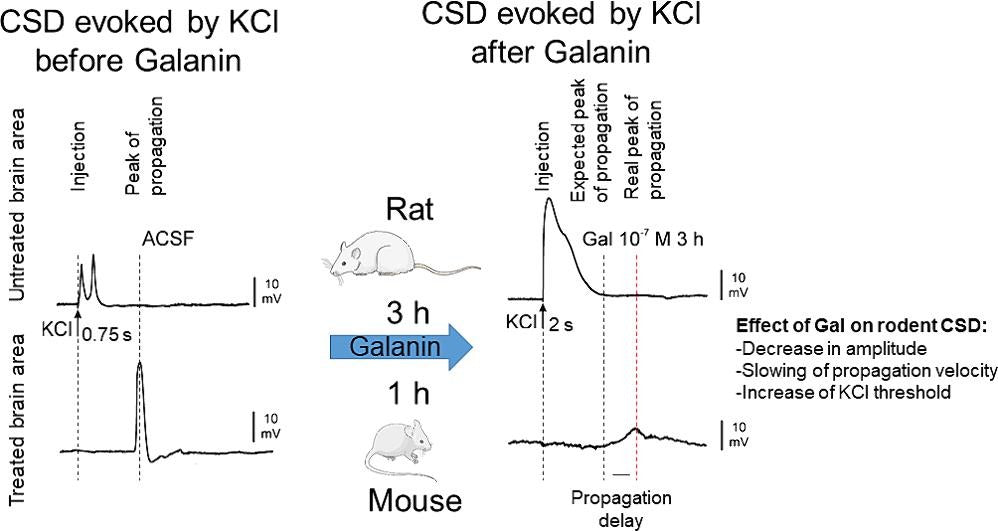
A recent study has found that galanin, a neuropeptide, may be a potential new treatment target for migraine with aura. Galanin significantly reduced the severity and spread of cortical spreading depolarizations (CSDs), which are believed to be the underlying cause of visual, sensory, and language disturbances during migraine aura.
The study, conducted on rats and mice, revealed that galanin:
1.Reduced CSD amplitude and propagation speed in the brain
and
2. Increased the threshold of stimulation required to trigger CSDs
These findings suggest that developing galanin agonists can enhance galanin's effects in the brain and could offer a novel approach to managing migraine with aura.
Stopping or reducing the severity of CSD could benefit migraine patients in several ways:
1. Reduced aura symptoms: By inhibiting CSD, visual, sensory, or language aura may be lessened or eliminated.

2. Decreased migraine pain: CSD may trigger or worsen migraine headache pain. Stopping CSD could potentially reduce the intensity or duration of migraine headaches.
3. Improved quality of life: Minimizing aura symptoms through CSD inhibition may allow migraine patients to experience less disability.
4. Potential prevention of migraine chronification: Frequent migraine attacks with aura have been linked to an increased risk of developing chronic migraine. Targeting CSD may slow or prevent the progression from episodic to chronic migraine.
5. Reduced risk of associated neurological conditions: Migraine with aura may be associated with an increased risk of certain neurological conditions, such as stroke. Stopping CSD could potentially reduce this risk.
While further research is still necessary to validate these results in humans, the identification of galanin as a potential treatment target is significant.

Where to next?
Pick a topic and dive into more free, research-backed guides in the Migraine Resource Hub.


Vestibular Rehabilitation for Vestibular Migraine: What 7 Studies Show
Seven studies and 272 adults with vestibular migraine show a pooled 23.97 point drop in dizziness handicap after vestibular rehabilitation, above the usual threshold for clinical meaningfulness. Balance confidence did...
Read More
Botox for Chronic Migraine: What 479 Real-World Patients Show
A 479-patient real-world study of onabotulinumtoxinA for chronic migraine found a mean reduction of 5.9 monthly headache days, with 27.3% reaching the 50% response threshold and 41.6% shedding medication overuse....
Read More
The New Migraine Prevention Guideline: What the AAN and AHS Recommend
The American Academy of Neurology and the American Headache Society have published a joint practice guideline on migraine prevention in adults: 17 recommendations and 52 statements. It names no single...
Read More


