


















Adrenomedullin Set Off Migraine-Like Headache in Most Adults With Post-Traumatic Headache
In a small Brain trial, an adrenomedullin infusion set off migraine-like headache in 17 of 21 adults with post-traumatic headache, compared with 4 of 21 after placebo.


 Study at a glance
On this pageJump to a section6
Why This Study Was Done
Headache that starts after a concussion and does not go away is called persistent post-traumatic headache. Many people with it describe attacks that look a lot like migraine: throbbing pain, light and sound sensitivity, nausea. Even so, it has far fewer treatments built for it than migraine does.
The Danish Headache Center in Copenhagen has spent years testing which body chemicals can set off headache when given through an IV. That approach helped establish the role of CGRP in migraine and later of PACAP. This new study, published in Brain, asked the same question about adrenomedullin, a blood-vessel peptide from the same family as CGRP that partly shares its receptor system.
Adrenomedullin is a small signaling peptide that widens blood vessels. It belongs to the calcitonin peptide family, the same family as CGRP, and the two overlap in the receptors they use. The authors describe it as a candidate treatment target in migraine.
How the Trial Worked
This was a single-center, double-blind, placebo-controlled crossover trial. Each person served as their own comparison, which cuts down on the noise you get when comparing two separate groups.
- Who took part: adults with persistent post-traumatic headache after a mild traumatic brain injury, and no history of migraine before the injury. Of 158 people screened, 21 were randomized, and all 21 completed both study days.
- Who they were: mean age 34.3 years, 19 of 21 (90%) women, and 18 of 21 (86%) with a migraine-like pattern to their usual headache.
- What they received: a 20-minute IV infusion of adrenomedullin on one day and salt water (placebo) on another, at least 7 days apart, in random order. Neither participants nor staff knew which infusion was which, a design feature called blinding.
- What was measured: whether a migraine-like headache developed within 12 hours (the main outcome), plus overall headache intensity over those 12 hours.
Because no one had migraine before the injury, the headaches the infusion triggered cannot be explained by a pre-existing migraine tendency.
What They Found
Looking at each person across both days, 14 participants developed a migraine-like headache only after adrenomedullin, and 1 developed one only after placebo. That works out to a paired absolute risk difference of 61.9 percentage points, with a 95% confidence interval of 29.7 to 80.6 points. The two-sided p-value was 0.001.
| Outcome | Adrenomedullin | Placebo (saline) |
|---|---|---|
| Migraine-like headache within 12 hours | 17 of 21 (81%) | 4 of 21 (19%) |
| Median time to migraine-like headache | 30 minutes | 390 minutes |
| Headache intensity over 12 hours (median area under the curve) | 1,110 | 420 |
| Took rescue medication | 10 participants | 2 participants |
Total headache burden over the 12 hours was also higher after adrenomedullin than after placebo (p = 0.006). Ten people needed rescue medication after adrenomedullin, compared with 2 after placebo.
What It Means for People With Post-Traumatic Headache
The finding suggests that adrenomedullin signaling is active in persistent post-traumatic headache, and that people with this condition respond to it strongly. The authors conclude that the adrenomedullin pathway is a candidate target for developing treatments designed around this mechanism.
That is a research finding, not a new therapy. No drug that blocks adrenomedullin is available, and this study did not test any treatment. Current CGRP-targeted preventives, such as erenumab (Aimovig), fremanezumab (Ajovy) and atogepant (Qulipta), were not part of the trial, so it cannot tell us whether any of them blunt the adrenomedullin response. If you are curious where those drugs fit, our list of CGRP medications covers the current options, and our overview of drugs in the migraine pipeline shows where newer targets stand.
For now, post-traumatic headache with migraine-like features is usually managed with the same toolkit used for migraine, chosen by a physician based on the headache pattern. People who take pain relievers on many days a month after a concussion should keep the risk of medication overuse headache in mind and raise it with their clinician.
- A 20-minute adrenomedullin infusion triggered migraine-like headache in 17 of 21 adults with persistent post-traumatic headache, compared with 4 of 21 after placebo.
- None of the participants had migraine before their head injury.
- Triggered headaches started a median of 30 minutes after the infusion, and 15 of 21 people said they resembled their usual headache.
- The results point to adrenomedullin as a possible treatment target. No adrenomedullin-blocking treatment exists yet.
Limitations to Keep in Mind
- Small group, one center. The sample size was 21 people at a single headache center in Denmark. The authors say the findings need confirmation in independent groups.
- Mostly women. Nineteen of 21 participants were women, so the results may not apply equally to men with post-traumatic headache.
- A trigger study, not a treatment study. Showing that a substance sets off headache does not prove that blocking it will prevent headache. The authors call for complementary laboratory studies before drawing treatment conclusions.
- No healthy comparison group. The trial included only people with post-traumatic headache, so it cannot show how much more sensitive this group is than people without headache.
The paper lists the dose as 19.9 picomoles per kilogram per minute for 20 minutes, with headache recorded for 12 hours after each infusion.
This article is for educational purposes only and does not replace medical advice, diagnosis or treatment. Adrenomedullin infusion is a research procedure and is not a treatment. Talk with a qualified clinician about any headache that began or changed after a head injury.
References
- Al-Khazali HM, Hakimzadeh Z, Melchior AG, et al. Hypersensitivity to adrenomedullin in post-traumatic headache: a randomized crossover study. Brain. 2026. doi:10.1093/brain/awag401.
Get studies like this by email
Every Friday, the week's migraine studies and news explained in plain language. No ads.
From Cerebral Torque
Our book, our rollers and our tracker. Here is what the people who use them say.


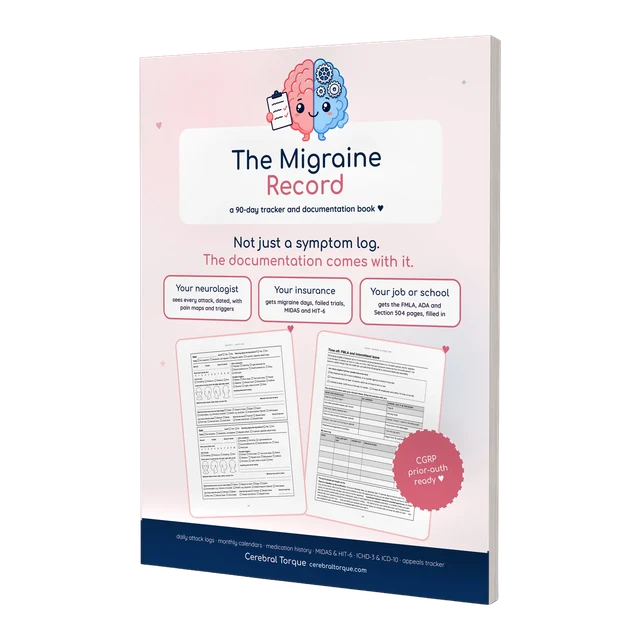
“The ultimate blueprint to navigate migraine care.”
Olivia Begasse de Dhaem, MD, headache specialistSee it on Amazon“This is my favorite migraine roll-on that I’ve tried, and I’ve tried quite a few.”
Verified Amazon buyerSee it on AmazonA different formula with more cold. Quick, deep and layered.
Maximum cooling roll-onSee it on AmazonA paper tracker laid out the way neurologists and insurers ask for it.
Tracker and documentation bookSee it on Amazon
About the author
Founder of Cerebral Torque and author of Unraveling Migraine, with a medical background. Trained in computational and cellular neuroscience, with research using Hodgkin-Huxley modeling and clamp electrophysiology to study how neurons respond to rhythmic input. Now focused on migraine medicine and education, and has produced CME for clinicians on hormone therapy, migraine, and HRT delivery.
More about the author Editorial standardsThis article is for education and is not medical advice. Talk with your own clinician before starting, stopping or changing any treatment.
More on CGRP medicines

CGRP Migraine Drugs and Women's Health, From Periods and Pregnancy to Breastfeeding and Birth Control
A review of 16 studies on CGRP drugs during periods, pregnancy, breastfeeding and birth control.
Nurtec ODT (Rimegepant) for Migraine, Uses, Dosage and Side Effects
Nurtec ODT (rimegepant) is the one gepant approved to both treat migraine attacks and prevent episodic migraine. Dose, trial results, side effects, interactions, generic status and…

Who Responds Best to CGRP Antibodies
No test predicts who will respond to a CGRP antibody, but migraine features shift the odds. We review every studied predictor, from triptan response to daily…